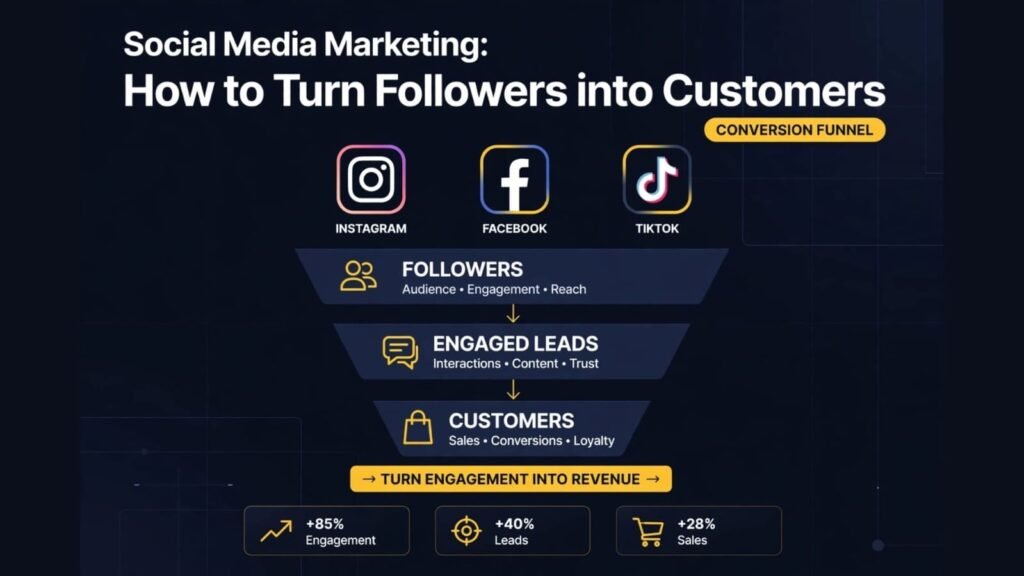
Having thousands of followers on social media is great, but what if those followers never become your customers? In today’s digital world, success is not just about getting likes, comments, and shares. It is about building trust, creating meaningful connections, and encouraging people to take action.
Social media marketing helps businesses connect with their target audience, showcase their products or services, and turn interested followers into paying customers. With the right strategy, your social media platforms can become powerful tools for business growth.
In this blog, we will explore practical ways to turn your social media followers into loyal customers.
Understand Your Target Audience
The first step towards converting followers into customers is understanding who they are. You need to know their interests, needs, challenges, and buying habits.
Ask yourself these questions:
Who is my ideal customer?
What problems are they trying to solve?
What type of content do they enjoy?
What motivates them to purchase a product or service?
For example, if you are promoting a skincare brand, your audience may be interested in skincare routines, product recommendations, and solutions for common skin concerns.
When you understand your audience, you can create content that speaks directly to their needs and encourages them to engage with your brand.
Create Valuable and Engaging Content
Content plays an important role in social media marketing. People are more likely to trust and follow brands that provide useful information rather than constantly promoting their products.
Try creating different types of content, such as:
Educational content: Share tips, tutorials, and helpful information.
Entertaining content: Use relatable posts, humour, and creative videos.
Behind-the-scenes content: Show how your business operates.
Product demonstrations: Explain how your products or services work.
Customer success stories: Highlight real customer experiences with permission.
The goal is to provide value before asking people to buy. When followers find your content helpful, they are more likely to remember your brand and consider your products or services when they need them.
Build Trust Through Consistency
Trust is one of the biggest factors influencing purchasing decisions. People usually prefer buying from businesses they know and trust.
To build trust, maintain a consistent posting schedule, use a recognisable brand identity, respond honestly to questions, and share genuine information about your products or services.
You can also share customer reviews, testimonials, frequently asked questions, and real examples of your work.
Avoid making unrealistic promises or using misleading claims to attract attention. Building genuine relationships may take time, but it can help create long-term customers and stronger brand loyalty.
Use Strong Calls to Action (CTAs)
A call to action, commonly known as a CTA, tells your audience what to do next. Even if your content is interesting, followers may not take action unless you guide them.
Here are some examples of effective CTAs:
To generate enquiries: “Send us a DM to learn more.”
To increase website traffic: “Visit our website to explore our services.”
To encourage purchases: “Shop now and find your perfect match.”
To generate leads: “Download our free guide today.”
To encourage bookings: “Book your consultation today.”
Make your CTA simple, clear, and relevant to the content. Avoid giving too many instructions in a single post.
A well-placed CTA can help turn a casual viewer into an interested prospect and move them closer to making a purchase.
Use Stories and Reels to Showcase Your Products
Short-form videos and social media Stories are effective ways to capture attention and demonstrate the value of your products or services.
Instead of simply posting product photographs, show your audience how your product works, what makes it useful, and how it can solve a problem.
For example, a clothing brand could create a Reel showing different ways to style one outfit. A digital marketing agency could share a short video explaining common SEO mistakes.
You can also use Stories to share product updates, answer questions, conduct polls, and direct followers to your website or enquiry page.
Remember that the purpose is not just to gain views. Your content should help people understand why your offering is relevant to them.
Make the Buying Process Easy
Sometimes, followers are interested in purchasing but leave because the process is confusing or time-consuming.
To improve conversions, make sure your social media profiles provide all the essential information.
Check that your profile includes:
A clear description of your business.
A link to your website or product page.
Easy ways to contact you.
Clear product or service information.
Simple instructions for ordering or booking.
If customers need to send a message to enquire, respond promptly and provide accurate answers. If you sell through a website, make sure the checkout process is simple and mobile-friendly.
The fewer unnecessary steps customers need to take, the easier it becomes for them to complete a purchase.
Use Social Proof to Influence Buying Decisions
People often look for reassurance before purchasing something new. Social proof helps provide that reassurance by showing that other people have had positive experiences with your brand.
You can build social proof by sharing genuine customer reviews, testimonials, user-generated content, case studies, and successful project results.
For example, a digital marketing professional could showcase a case study explaining how a campaign improved website traffic or generated more enquiries, provided the results are accurate and the client has approved their use.
Always seek permission before sharing private customer messages, photographs, or identifiable information. Never create fake reviews or invent customer results.
When potential customers see credible evidence of your work, they may feel more confident about choosing your business.
Turn Conversations into Sales
Social media is not just a platform for publishing content. It is also a place to build relationships through conversations.
When followers comment on your posts or send direct messages, use the opportunity to understand their needs and offer relevant help.
For example, if someone asks about your digital marketing services, you can explain the available options, ask about their business goals, and recommend a suitable service.
Avoid sending aggressive sales messages or repeatedly pressuring people to purchase. Instead, focus on answering questions, solving problems, and helping them make informed decisions.
A friendly and professional approach can turn an ordinary conversation into a valuable business opportunity.
Use Targeted Social Media Advertising
Organic content helps you build relationships with your existing audience, while paid advertising can help you reach more relevant people.
Platforms such as Facebook and Instagram offer advertising tools that businesses can use to reach audiences based on available targeting options, interests, and behaviours.
You can use paid campaigns to:
Promote specific products or services.
Generate enquiries and leads.
Drive traffic to landing pages.
Reach people who have previously interacted with your business.
Retarget eligible website visitors or social media audiences.
Start with a clear campaign objective and a realistic budget. Test different creatives, messages, and audiences, then review the results before increasing your spending.
Paid advertising works best when it is supported by a clear offer, a relevant audience, and an easy path to conversion.
Track Results and Improve Your Strategy
A successful social media marketing strategy requires regular monitoring. Do not judge your performance only by the number of followers or likes you receive.
Instead, track metrics that are connected to your business goals.
Important metrics include:
Engagement rate: Shows how people interact with your content.
Link clicks: Measures how many people click your links.
Conversion rate: Shows the percentage of visitors who complete a desired action.
Leads generated: Measures how many potential customers contact your business.
Cost per lead: Helps you understand how much you spend to generate a lead through advertising.
Sales and revenue: Show the business results generated by your marketing activities.
Use the analytics tools available on your platforms and website to identify which content attracts the right audience and which campaigns produce meaningful results.
Review your performance regularly and make improvements based on the data. This helps you spend your time and budget more effectively.
The Customer Journey: From Follower to Buyer
Turning followers into customers usually happens through several stages.
Step 1: Awareness — People discover your brand through posts, Reels, recommendations, or advertisements.
Step 2: Interest — They explore your content and learn about your products or services.
Step 3: Trust — They read reviews, watch demonstrations, and interact with your business.
Step 4: Action — They visit your website, send an enquiry, book a consultation, or make a purchase.
Step 5: Loyalty — A positive customer experience encourages repeat purchases, referrals, and long-term relationships.
Understanding this journey helps you create the right content for people at different stages of their buying decisions.
Common Mistakes to Avoid
Even a business with an active social media presence may struggle to generate sales if its strategy is not focused on customers.
Avoid these common mistakes:
Posting only promotional content.
Ignoring comments and direct messages.
Using unclear calls to action.
Buying fake followers or engagement.
Focusing on follower count instead of business results.
Making it difficult for customers to contact you or purchase.
Failing to review campaign performance.
Focus on attracting the right audience, providing genuine value, and making the next step clear.
Conclusion
Turning social media followers into customers requires more than attractive posts and a growing audience. It takes a clear strategy, valuable content, consistent communication, customer trust, and a simple buying process.
By understanding your target audience, using effective calls to action, sharing genuine customer experiences, and tracking your results, you can transform social media into a valuable channel for business growth.
Remember, every follower may not become a customer, and that is perfectly normal. Your goal is to build meaningful connections with the people who genuinely need what your business offers.
Start with small improvements, measure your progress, and keep refining your strategy. With patience and consistency, social media marketing can help you attract potential customers and build lasting relationships.
Ready to Grow Your Business with Social Media Marketing?
Want to attract the right audience, increase engagement, and turn followers into paying customers? Let’s create a social media marketing strategy that connects your brand with the people who matter most.
Get in Touch Today to discuss how strategic social media marketing can help your business grow.